

From Buzzword to Backbone
In many ways, AI is still functioning as a buzzword. AI hype is felt circulating around at all industry trade shows and in the media. At the same time, many organizations are feeling pressure in areas, such as increasing costs, talent shortages, and ESG compliance, where a successful implementation of AI could bring valuable support to operations.
2025 was the year of AI Agents, and we saw a rise in use of ChatGPT and Co-Pilot, as well as value-packed functionalities like AI-Powered Transcription in Microsoft Teams and Google’s AI Mode. With these, we saw a shift from just individual/personal use to grander full-company rollout implementations. The success of these AI tools in practice has been widespread and visible, and has led to more leadership teams asking for AI to be incorporated into different areas within their company strategies. But, with AI success, there also comes risk.
The possibilities that AI can bring to RE and FM operations are transformational, but the path to many of those possibilities still isn’t clear for many organizations. For instance, implementing AI is not going to fix years of bad data management or broken operational processes with just a click of the mouse. In fact, organizations will need a better handle on their data than ever before in order to benefit from AI. They will also have to understand and mitigate security risks and ensure their IT teams are equipped to educate all users around the use of AI.
So, if your organization is ramping up to incorporate AI in your operations, you should not treat it as just a matter of turning on a new “feature” or “add on”. It’s a transformational change for your organization, and you need to know why you’re asking for it in order to prepare correctly.
AI as a framework; not just a feature
The most important takeaway for RE & FM teams entering the AI conversation is that AI is not a feature; it’s how you will be running operations within the next decade.
AI should be viewed as a framework. As something embedded within your full operations, not just a standalone feature. But, do not fear! If you and your teams aren’t ready to charge full speed ahead with AI into your RE & FM operations, you aren’t alone. AI is a curveball for many organizations right now. In fact, it’s a curveball for many vendors too! But, the potential of AI should not be ignored. Instead, organizations should continue to drive the conversation around AI use cases. AppsCRE, LLC started an interesting conversation on LinkedIn about the convergence of AI maturity between technology buyers and providers and posted this graphic.
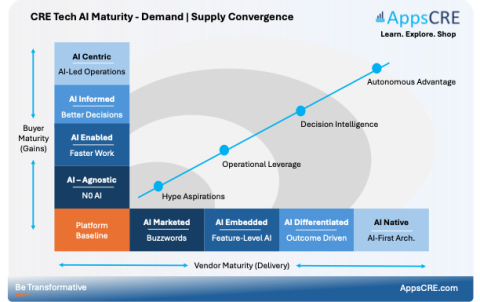
This graph from AppsCRE, LLC explores CRE Tech AI Maturity from both a Buyer and Vendor Maturity perspective.
Before you chase “AI” as a general capability, ground it in the systems and decisions that actually run buildings. In real estate and facilities, readiness usually isn’t about whether you want AI—it’s whether your BAS/BMS, CMMS, IWMS, and utility/meter data can be connected cleanly enough to answer a single operational question. If your asset names don’t match across systems, work orders live in messy notes, or meter-to-space mapping is incomplete, AI won’t magically fix that—it will just automate confusion faster. The good news: you don’t need perfection. However, you do need a clear first use case, minimum viable data access, and a workflow owner who can act on insights.
Here are 3 questions you and your teams should discuss to determine the best way to incorporate AI into your operations to generate measurable, repeatable value.
Data foundation: Where does your information live today? (BMS, IWMS, HR, Finance, Sensors, etc.)
Use-case lens: What are the problems your teams are facing right now? Here are some areas where AI is already making waves for RE & FM teams:
- Adaptive Maintenance
- Comfort Control
- Energy Demand
- Space Utilisation
- Operational Efficiency
- Employee Wellbeing
- People & Processes: Who uses the insights, who trusts them, who acts upon them?
If you and your teams are comfortable aligning on these questions, then you should already have some clear ideas on where you’d like to start piloting some AI projects. That means you should also already have the ability to craft more in-depth questions around AI in your RFPs & RFQs. In our next blog, we will share a helpful AI Readiness Checklist & 4 steps you can take to get an AI pilot launched in 90 days. Don’t miss blog 2 of this 3-part series on “AI for RE & FM.”