If you’re leading real estate or facilities teams today, you’re no stranger to making decisions fast, and often without the visibility you wish you had. Systems, data and expectations advance quickly, yet the way we talk about “digital maturity” hasn’t kept up with that pace. And yet, one pattern stood out clearly in our recent research: many organizations feel confident about their maturity, even when they aren’t working from a shared or structured baseline.
That gap isn’t just a flaw. It’s the natural outcome of years of local improvements, individual expertise, and function-by-function progress. But it does mean this: you can’t improve what you can’t clearly see.
That’s exactly what our upcoming webinar on Thursday, April 16th at 8:00 AM Central / 9:00 AM Eastern is designed to address. It offers an early look at the Digital Maturity Model for RE & FM, developed by Planon & Verdantix and based on 30 interviews and expert validation sessions. It’s a sneak preview of a model that aims to give organizations something the market has long been missing: a clear, evidence-based baseline to understand where they stand today, and how to proceed.
Why does the market needs a shared baseline before any benchmarking?
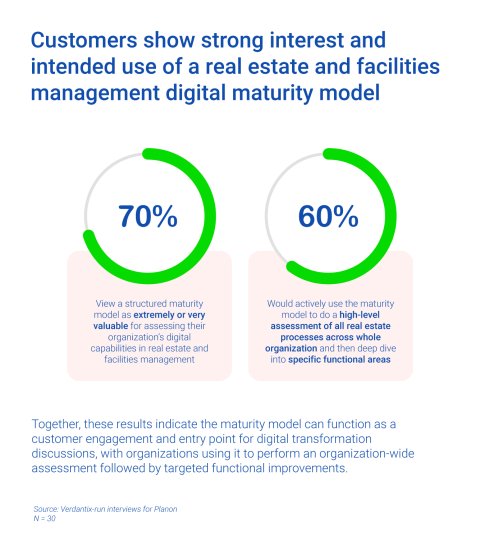
Across those 30 conversations, one insight came through consistently: confidence is high, familiarity with maturity models is low. Leaders can articulate strengths in individual domains, but rarely share the same language or criteria for what “mature” looks like across the whole organization.
Right now, this model is intentionally designed as a baseline assessment, not a benchmarking tool (yet!). It helps you:
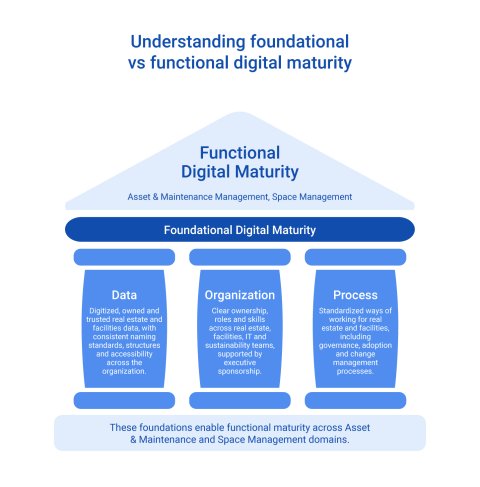
- See your current state across the foundational elements: data, processes and organization
- Understand where inconsistencies or blockers might be holding back progress
- Create internal alignment by starting conversations from the same picture instead of separate assumptions
- Identify which foundational gaps must be addressed before functional layers (Space & Workplace Services Management, Asset & Maintenance Management, and later Energy & Sustainability Management and Real Estate Management) can deliver meaningful value
Foundational-first perspective
This foundational-first perspective resonated strongly with the interviewees. Many organizations jump to functional ambition before resolving underlying issues, especially data hygiene and cross-departmental process coherence. A clear baseline helps prevent that misfire.
Be the first to see it in our upcoming webinar
This webinar will be a preview of what’s to come. John de Beijer (Planon), Joy Trinquet (Verdantix), and Matt Tucker (IFMA) will walk the audience through:
- Key patterns emerging from 30 interviews and IFMA validated input
- Why strengths tend to be local rather than holistic
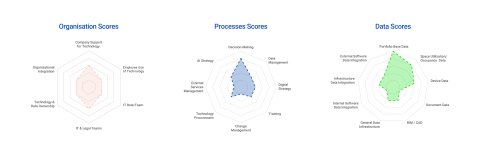
- How spider graphs visualize maturity across foundational and functional dimensions
- What the model can reveal today, and what we expect it to unlock in later phases (including peer-to-peer comparative assessments and industry best practices)
- How a shared baseline can strengthen business cases and decision making
- The evolving roles of FM & why it matters for digital maturity
- Why organizations want structure, language and visuals they can immediately use internally
We’re excited to showcase what this new tool can do. It already gives RE & FM leaders something powerful: clarity. A structured way to answer questions like:
- Where do we actually stand today?
- Are we making real progress, or just feel like we are?
- Do our teams have a shared view of maturity or are we working from different assumptions?
Join us on 16 April
If you’re looking to challenge your intuition with data-driven insight, and you are looking for a way to get a clearer view of your digital maturity before making your next technology investment – this session is for you.
Register now and be among the first to see where your organisation really stands.