

When I talk with customers, I hear the same challenge again and again:“We have so much data about our buildings, but turning it into real value is hard.”
I recognize that. At Planon, we have always believed that IWMS should be more than a system of record, and that it should help people make better decisions. Today, with artificial intelligence (AI) embedded in our platform, we are not only helping people make better decisions, but we are helping buildings think for themselves.
From Data to Decisions: AI-Powered Insights
For years, organizations have been monitoring space use, asset performance, energy consumption, contracts, and services. The issue has never been about collecting data — it’s about how to use it effectively.
That’s where AI makes a difference when paired with IWMS, as it allows IWMS to move beyond simple reporting to become a system of intelligence that can interpret, predict, and act.
What Does That Look Like?
- A facility request no longer starts with a form. The Planon Assistant listens and creates the ticket in natural language.
- A contract renewal no longer requires hours of review. AI summarization shows the key terms and deadlines.
- Maintenance is no longer a fixed calendar event. Adaptive AI predicts the right moment to service an asset.
- A backlog of work orders no longer overwhelms. Smart triage prioritizes them by urgency and history.
- And in multilingual environments, the translation engine ensures everyone can interact in their own language.
These are not distant visions. They are examples of AI that are already embedded in Planon today.
Looking for a plain English explanation on AI vs. ML vs. LLMs?
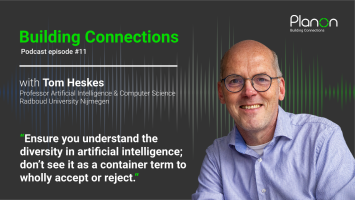
Then listen to this Planon podcast from IFMA fellow Erik Jaspers with professor Tom Heskes. Together they dissect real value, responsible adoption, and practical applications for strategists and knowledge workers.
Why Embedded AI Matters for Your Platform
Many vendors offer AI as an external add-on, but at Planon, we chose a different route, which was to build AI into the core of the platform.
That means:
- Every module and process can benefit immediately.
- Customers can configure and scale AI use cases themselves.
- Data remains unified, validated, and GDPR-compliant.
- New capabilities can be rolled out consistently across the ecosystem.
Embedding AI this way ensures it is not only powerful, but also useful, safe, and responsible.
From Fixed Rules to Predictive Intelligence
I often describe the shift like this:
Rules say, “Service this pump every six months.”
AI says, “This pump will need service in three weeks based on how it’s running.”
Rules say, “Switch on the lights when someone enters.”
AI says, “Dim the lights, because in five minutes, this area will be empty.”
This is how we move from smart buildings to thinking buildings, which are workplaces that don’t just react, but anticipate, support, and evolve.
Your Journey to a Smarter, Thinking Workplace
As CTO, I’m proud that Planon already delivers embedded AI use cases today, but I also know this is just the start. Each organization will take its own path - some beginning with energy optimization, and others with workplace services or contract management.
That is why we see this as a journey we take together. We bring the platform and embedded intelligence, and you bring your priorities and context. Together, we can create workplaces that truly work with you.
The Road Ahead
With every new Planon release, more AI capabilities become available, including predictive asset care, natural language interfaces, digital twins, and ecosystem-wide assistants.
Our mission stays clear: empower people, reduce complexity, make operations more sustainable, and turn data into action.
Because the workplace of the future is not just a building you use, it’s a building that thinks alongside you.