For years, Integrated Facilities Management (IFM) and Field Services Management (FSM) organizations have invested heavily in automation. Faced with contract margin pressure, performance-based models, sustainability targets, compliance requirements, and an aging workforce, the focus has been on driving efficiency through automation. Work orders became digital, dispatching became smarter, and manual processes were replaced with workflows. These investments delivered improvements. But today, simply automating tasks is no longer enough.
Organizations are starting to focus on automating business outcomes instead of solely automating tasks. This shift is paving the way for autonomous service operations.
Moving Beyond Task Automation
Automating tasks focused on execution; it helped organizations perform predefined activities faster and more consistently, e.g., generating work orders automatically or scheduling maintenance based on fixed rules. While valuable, these approaches remain task oriented.
Automating outcomes requires a different approach. Instead of concentrating on individual tasks, the focus is on business objectives such as asset uptime, SLA compliance, cost control, and sustainability goals. Workflows are no longer static. They continuously adapt based on real-time data, changing conditions, and business priorities.
This evolution is being driven by technologies like agentic AI, predictive analytics, and hyperautomation-orchestration platforms. Together, they create systems that can learn from operational data, anticipate future events, and recommend or execute actions that keep desired outcomes on track.
The Road to Autonomous Operations
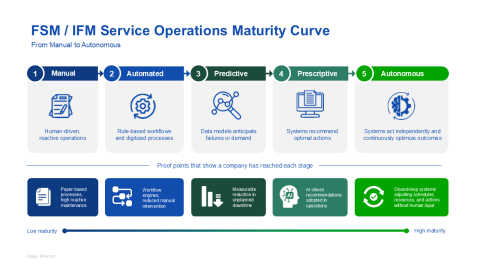
Organizations do not become autonomous overnight. Most follow a clear maturity path as their service operations evolve.
The journey typically progresses through five stages:
- Manual: Human-driven, reactive operations, often paper-based.
- Automated: Rule-based workflows and digitized processes.
- Predictive: Data models anticipate failures or demand, reducing unplanned downtime.
- Prescriptive: Systems recommend optimal actions.
- Autonomous: Closed-loop systems continuously optimize outcomes with human intervention only focused on exceptions rather than routine decisions.
Every stage builds on the one before, because organizations cannot use AI to compensate for poor data quality, fragmented systems, or broken processes. Autonomy amplifies what already exists. It does not fix what is fundamentally broken.
Human Expertise Remains Essential
One of the biggest misconceptions about autonomous operations is that they remove people from the equation. In practice, autonomy changes how human expertise is applied. People remain responsible for handling complex situations, managing exceptions, governing AI systems, and making strategic decisions. Autonomous technology operates within rules and objectives that are established and continuously refined by humans.
This is also why autonomy plays a critical role in improving the Total Experience across service organizations. Technicians benefit from better information and clearer guidance, improving first-time fix rates, and job satisfaction. Customers are informed before issues escalate rather than after something breaks. End users enjoy seamless services that work reliably in the background.
When implemented effectively, autonomous operations improve experiences across the entire service ecosystem while allowing employees to focus on higher-value work.
Why Many Organizations Are Still Early in the Journey
Although the vision of autonomous service operations is compelling, most organizations are still somewhere between the automated and predictive stages of maturity.
Fragmented technology landscapes remain a major obstacle. Many organizations continue to manage assets, workforce scheduling, IoT, and analytics through separate systems that do not communicate effectively with one another. As a result, valuable operational data remains trapped in silos.
Trust presents another challenge. Organizations must have confidence in AI-driven decisions before embedding them into critical workflows. That trust is built through transparency, explainability, and consistent results over time. Without it, even mature technologies struggle to gain widespread adoption.
Turning Data Into Decisions
Many service organizations are not short on data. The real challenge is turning that data into action. Dashboards and reports can provide visibility, but visibility alone does not create business value.
Value is created when insights are embedded directly into operational processes and decision-making. This is where orchestration becomes essential. Organizations need a connected view of assets, service activities, workforce capacity, and customer commitments so they can make informed decisions in real time rather than reacting after the fact. Platforms such as Planon's Facility Services Management (IFM & FSM) solution help bring these operational data streams together, creating the foundation required for increasingly predictive and autonomous service delivery.
The result is a self-optimizing operating model that reduces inefficiencies in resource allocation, lowers reactive maintenance costs, prevents SLA breaches, and supports real-time decision-making. At the same time, it helps facility services organizations deliver better customer experience, employee experience, ROI/IRR, and achieve sustainability objectives, differentiating them from their competitors.
The Future Belongs to Outcome-Based Autonomous Service Operations
The organizations that will lead the next generation of service operations are not necessarily those experimenting the most with AI. They are the ones that successfully bring together data, processes, people, and technology to operationalize AI at scale.
They will also recognize that technology alone is not enough. Building organizational trust, investing in change management, and ensuring transparency in autonomous decision-making will be just as important as the technology itself.
In the coming years, the real differentiator will not be automation speed. It will be the ability to operate continuously, adapt intelligently, and deliver consistent outcomes while quietly improving the Total Experience for technicians, customers, and end users alike.