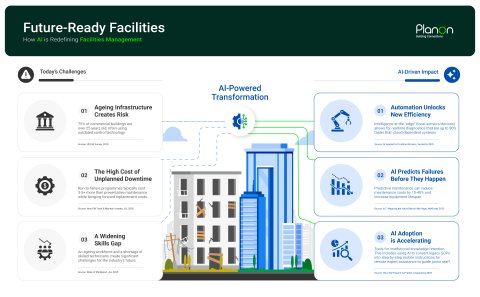
Ageing infrastructure is becoming one of the biggest operational risks facing facility management teams. Across offices, hospitals, public buildings and commercial estates, critical HVAC, electrical, plumbing, and mechanical assets are at or beyond their design life, and the result is familiar: more failures, higher maintenance costs, rising energy consumption and greater compliance exposure.
The question is no longer whether ageing infrastructure creates risk. It clearly does. The real question is how FM leaders can reduce that risk while creating measurable business value. AI-powered transformation offers a practical route, not a futuristic concept, but a way to make facilities more visible, predictive, and resilient.
VIEW INFOGRAPHIC
Redesign the workflow, then automate the baseline
Automation is often seen as the first step towards modernisation. But it only creates value when it is applied to the right processes. Many ageing facilities are managed through legacy workflows, manual handovers, and local workarounds that have been built over time. If those processes are automated as they are, poor ways of working simply become faster and bad data becomes more consistent and harder to unwind.
FM leaders should therefore define the future-state workflow first: how work is requested, prioritised, assigned, completed, escalated, and measured. Do not automate the past. Redesign the workflow first, then automate the future state.
With the right workflows in place, automation does what it does best. It can reduce manual effort, remove duplicated work, capture data consistently, and create better visibility across assets, buildings, and teams. Approaches such as Planon’s Objective-Based Maintenance build on these improved workflows, turning automation into both an operational and financial lever.
But the real power of automation is not efficiency. It is visibility. Teams cannot manage risk without a reliable view of how assets are performing. Automated data capture, smart controls, sensors, and connected workflows help establish a baseline: what normal asset behaviour looks like, where alarms cluster, how often interventions are needed and which assets are starting to deviate.
This is why automation must come before prediction. You cannot predict what you cannot measure. And you cannot optimise what you have not baselined.
Predictive maintenance turns visibility into prevention
Once workflows are clear and data is reliable, predictive maintenance becomes credible. AI and IoT-enabled monitoring analyse asset data, detect anomalies, and identify early warning signs before equipment fails. Instead of waiting for breakdowns, teams intervene earlier, plan work better and reduce building user disruption with research highlighting downtime reductions of up to 50% by catching equipment issues early and avoiding emergency fixes.
For ageing infrastructure, that is critical. Older assets may not be replaceable all at once, but they can be managed more intelligently. Predictive maintenance helps teams focus on the assets that carry the greatest risk and make better decisions about repair, replacement, and capital planning.
AI adoption scales value across FM operations
Broader AI adoption extends this value beyond asset monitoring. AI can support scheduling, dispatch, diagnostics, energy optimisation, and guided technician workflows. It can route the right person with the right parts, cut unnecessary callouts, and improve response times through remote diagnostics.
For FM service providers, that opens the door to outcome-based service models, where value is measured in uptime, energy performance, and customer experience. For in-house FM teams, it means skilled people can spend less time on manual triage and more time on higher-value work.
The future-ready facility is intelligent, not just modern
Ageing infrastructure will not disappear overnight. Budgets are limited, estates are complex and replacement cycles take time. But progress does not require modernising everything at once.
They can start by redesigning the right workflows. They can automate data capture and establish reliable baselines. They can use predictive maintenance to reduce failure risk. And they can scale AI adoption to improve productivity, energy performance, and long-term asset value.
That is how ageing infrastructure stops being a risk to manage and becomes value to capture.
Want to know more about AI in field services?
Watch this on-demand webinar led by Planon Solution Strategist, Tom Ryckaert: From AI Potential to Operational Impact: What It Really Takes to Transform Field Service.